

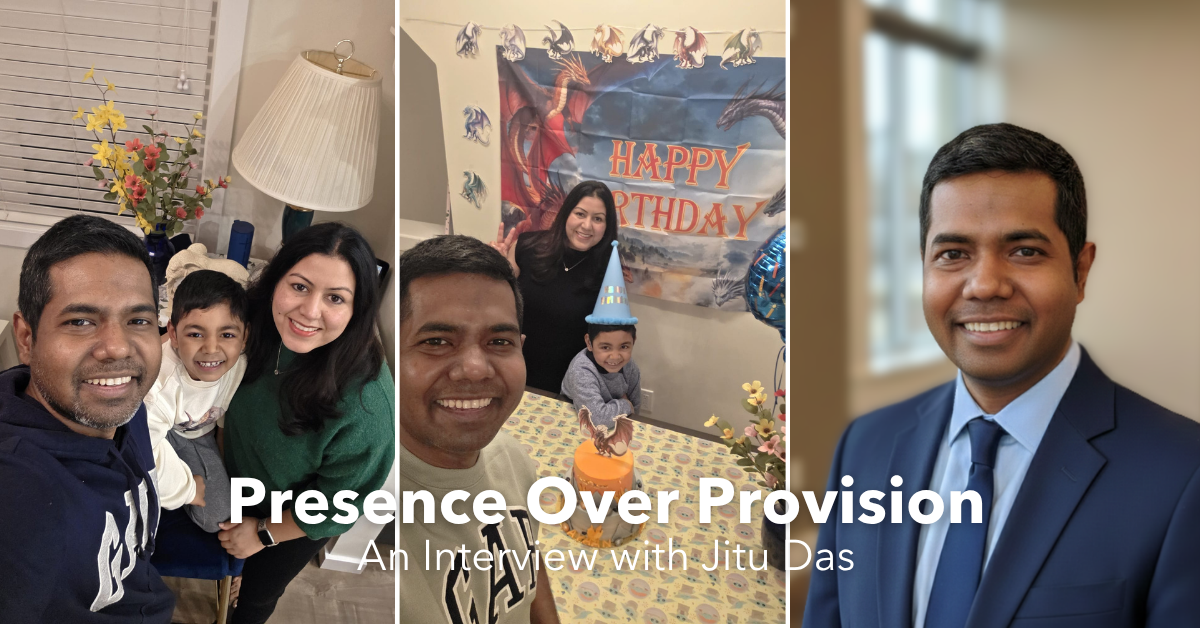
Reimagining Modern Fatherhood in the Corporate World

Author: Nidhi Gandhi, 2026 Social Media Committee Volunteer


"By the time you truly understand your father, you have become one yourself, and your father may no longer be in the world for you to tell him."


It's a thought that stays with Jitendra Das, and one that lands especially close around Father's Day.
 
Jitu, to those who know him, is a Senior Human Resources Business Partner at Amazon, where he partners with business leaders on organizational effectiveness, talent strategy, leadership development, and culture. Behind that work sits more than 16 years of HR experience across India, the Middle East, Southeast Asia, and North America. Alongside his corporate role, he is an ICF certified executive coach at the PCC level with over 2,500 coaching hours, having supported leaders across Fortune 500 companies in unlocking their potential and navigating personal and professional growth.

But the role that shapes everything else is a quieter one. He grew up watching a generation of fathers who showed love through provision, and made himself a different promise, to show it through presence. He wants his son, Ayaan, to remember the school runs, the bedtime stories, the nothing-in-particular evenings. As he puts it: "I am not building a career despite being a father. I am building it because of it."

This Father's Day, we interviewed Jitu to talk about what modern fatherhood asks of men at work, the leave they don't take, the bias they navigate quietly, and what it really means for a working father to feel safe being fully himself.

1. You are uniquely positioned to advocate for policies like parental leave for fathers. Do you feel a personal responsibility to champion men’s work-life balance and mental health in the corporate world?


Absolutely, and I think responsibility is the right word, not just opportunity. Men's mental health and work-life balance remain largely underdiscussed in corporate spaces, and the cost of that silence is real. Burnout, disengagement, and leaders who are physically present at work but emotionally absent at home, these are symptoms of a culture that never gave men permission to be human.


In Canada, fathers have access to parental leave, yet the uptake remains far lower than among mothers, not because fathers do not want to be present, but because the culture has not caught up with the policy. I want to help close that gap. Not just through advocacy in meetings, but by modeling it myself, being visible about my own boundaries, talking openly about Ayaan and what being present for him means to me, and making it easier for the men around me to do the same. If I cannot use my platform to normalize that, then what is it for?


2. Working fathers often face a subtle social bias where they are viewed as the 'secondary' parent. How can HR teams and leaders shift corporate mindsets to recognize and respect men as primary, equal caregivers?


The bias is real, and it often lives in the small things: a father who leaves early for his child's recital gets noticed differently than a mother who does the same thing, and a man who sets a hard stop for school pickup reads as less committed rather than more present. HR teams need to look at this structurally, because in Canada, parental leave is available to both parents yet the uptake among fathers remains significantly lower, and that gap is not about desire, it is about what leaders normalize. If no senior man in an organization has ever visibly taken parental leave, that silence is a message. I keep Ayaan's school events on my calendar and I do not hide them, because representation in everyday behaviour is more powerful than any policy document


3. There’s an old stereotype that fathers should always be the 'unshakable pillar.' How have you learned to embrace vulnerability, both as a dad and as a professional leader?


When we moved to Canada in 2022, I went through a period of professional uncertainty I was not prepared for, having built my career across India, the Middle East, and Southeast Asia and then starting over in a new market without the network I had spent years building. My wife Megha held the family steady during that time, and watching her do that taught me the difference between being a pillar and being a wall: she was not unaffected; she was grounded. I have told Ayaan when I have had hard days, not to burden him, but to show him that naming something difficult is not weakness, it is how you move forward. That same principle lives in how I coach leaders now: vulnerability is not the absence of strength, it is the honesty to say where you are, and that honesty builds more trust than any polished performance.


4. What does psychological safety look like for a working father? Have you ever felt pressure to hide family obligations to maintain a certain professional image?


Yes, early in my time in Canada I was careful about how much I revealed as a father in professional settings, because there is an unspoken test that working fathers navigate: prove your commitment by making your family invisible at work. But I think about Ayaan running to show me a drawing he made at school, not because it was perfect, but because he wanted me to see it, and that unconditional trust reminds me that the most important audience for how I show up is not in the boardroom. Psychological safety for a working father means being able to say I am leaving early for my son's event without it being read as a lack of ambition. The day that becomes unremarkable is the day we have actually made progress, and as HR professionals, building that culture is not a nice-to-have. It is the work.


A Wish for Father's Day
 
“Fatherhood did not soften my professional edge. It sharpened it, gave me a reason to build something worth being proud of, and a daily reminder of what I am actually working for. This Father's Day, my wish is simple: I hope working fathers across Canada and the world feel seen, take the leave they are entitled to, and show up for the bedtime stories. And I hope their organizations build cultures where none of that is a trade-off. Ayaan, this one is for you.”


Jitu's wish is a modest one, but the shift it asks of our workplaces is not. It asks for cultures where presence, honesty, and a hard stop for school pickup read as strength rather than absence, where showing up for your child is never a trade-off against showing up at work. 


This Father's Day, that feels like a goal worth building toward. Wishing everyone a Happy Father’s Day!


The views and opinions expressed in this blog post belong solely to the original author(s) and do not necessarily represent the views and opinions of CPHR Alberta.


By Jessica Jaithoo June 8, 2026
Author: Taia Northrup , 2026 Social Media Committee Volunteer Each year, on the second Saturday of June, people around the world come together to recognize International Wellness Day, a global movement dedicated to promoting healthier, happier, and more balanced lives. This special day serves as a reminder that well-being extends beyond physical health; it includes mental, emotional, social, and workplace wellness as well. As HR professionals, wellness is more than a personal responsibility, it is a workplace priority. The Chartered Professionals in Human Resources (CPHR) profession recognizes that healthy, supported employees are the foundation of engaged, productive, and resilient organizations. HR leaders play a key role in creating workplace cultures that foster psychological safety, work-life balance, employee engagement, and overall wellbeing. International Wellness Day encourages individuals, employers, and communities to reflect on the habits, environments, and relationships that contribute to overall wellbeing. In today’s fast-paced world, it can be easy to put our health on the back burner. This day provides an opportunity to pause, evaluate our wellness practices, and make meaningful changes that support long-term health and happiness. The celebration also aligns with the broader goals of workplace wellbeing initiatives, which focus on creating healthier organizations and communities. Research continues to show that employees who feel supported in their wellbeing experience lower levels of burnout, higher engagement, and stronger workplace satisfaction. Organizations that prioritize employee wellbeing also benefit through improved retention, productivity, and organizational resilience. From a CPHR perspective, wellbeing is not limited to wellness programs or fitness challenges. It involves taking a holistic approach that considers mental, emotional, physical, financial, and social health. Building supportive policies, encouraging meaningful work-life balance, and creating inclusive workplace cultures are all essential components of a successful people's strategy. Wellness looks different for everyone. For some, it may mean prioritizing physical activity, healthy nutrition, or quality of sleep. For others, it may involve managing stress, strengthening social connections, practicing mindfulness, or taking time for self-care. The important message is that small, intentional actions can have a significant impact on overall wellbeing. As we celebrate International Wellness Day, consider taking a moment to invest in your own health and happiness. Whether it’s going for a walk, connecting with loved ones, setting healthy boundaries, or simply taking time to recharge, every positive step contributes to a healthier and more fulfilling life. At its core, wellbeing is about creating environments where people can thrive—both at work and in life. As HR professionals and workplace leaders, we have the opportunity to champion initiatives that support our people, strengthen our organizations, and build healthier communities for the future. How will you invest in your wellbeing today? 
By Jessica Jaithoo May 22, 2026
Trust is the foundation of any successful workplace, and for Indigenous employees, it is defined by historical, social, and political realities that organizations must acknowledge and understand. Building trust with Indigenous employees goes beyond basic diversity policies to a more informed and meaningful action plan towards achieving a respectful, equitable workplace and a commitment to reconciliation. According to Alberta Learning Information Service (ALIS), a commitment to building a trusting relationship between employers and Indigenous employees is not only an ethical responsibility but also creates a strategic business advantage. Human Resources and leadership play a crucial role in building this trust by intentionally integrating inclusion, trust, and accountability into all aspects of the workplace. Understanding Trust in the Indigenous Workplace Context Trust for Indigenous employees is influenced by a history of colonization, systemic discrimination, and inequities that affect employment experiences today. Data from Statistics Canada (2022) reveals that Indigenous people are more likely to experience workplace discrimination than non-Indigenous employees (15.2% versus 9.1%), and they are also less likely to remain in roles long-term, with only 32.0% reporting tenures of 10 years or more compared to 37.3% of non-Indigenous workers. Statistics like these reveal the lower levels of psychological safety that Indigenous employees feel at work. Building psychological safety for this marginalized group therefore requires HR and leadership to move from performative inclusion to more meaningful and relationship-based practices that are centered around trust, respect, and inclusion. The Role of HR and leadership in Building Trust Building trust with Indigenous employees is a shared responsibility that requires both HR and leaders to work in sync. We will discuss the roles of both parties below. 1. Mentorship Indigenous employees who are new to the workforce might be unfamiliar with systems, procedures, and expectations. A mentorship program, opportunities for leadership development or training, or a buddy system that pairs them with an employee guide and supports them throughout their first few months or longer can be beneficial for these workers. An effective mentorship program will require organizational leadership to endorse and prioritize mentorship initiatives while HR works with managers to design and implement mentorship programs that will meet each employee’s development needs. When done right, Indigenous mentorship programs can bridge the cultural gaps and create safe spaces for growth and promote psychological safety. 2. Cultural Competency and Awareness Training Cultural competency has become a critical skill in managing today’s diverse workforce and the major aim of this training is to create awareness and/or improve the understanding of various cultures and beliefs in the workplace while equipping staff with skills required to seamlessly communicate, collaborate, and respectfully work with people from different backgrounds. Leaders must champion this training and promote a culturally respectful workplace culture. HR must lead the implementation of such training, ensuring it is structured, inclusive, and embedded across the organization and engage the right facilitators. 3. Providing Support for Emotional and Mental Well-being Supporting Indigenous employee well-being is another critical responsibility. To achieve this, organizational leaders must commit to fostering a culturally safe, trauma-informed workplace that respects Indigenous traditions, prohibits discrimination, and creates environments where Indigenous employees feel safe to speak up. Clear reporting avenues and prompt action to concerns should be addressed. HR’s part in this initiative is to provide Indigenous based employee assistance programs like Indigenous-specific counselling resources, elder support, and land-based healing programs where accessible. Also, promoting a supportive workplace culture, fostering inclusive team environments where Indigenous employees feel supported and valued. 4. Integrating Cultural Inclusion in Workplace Practices This is another shared responsibility between HR and leadership. HR plays a key role in designing and formalizing cultural inclusion practices such as starting corporate events with land acknowledgments, creating space for cultural practices like smudging, supporting flexible holidays for cultural celebrations, and ensuring that Indigenous memorial events such as the National Day for Truth and Reconciliation or Aboriginal Awareness Day are celebrated. The leadership role is to reinforce these commitments to cultural inclusion by openly supporting and participating in these initiatives, which shows that the organization regards cultural inclusion as a priority. 5.Supporting Career Advancement and Fair Performance Practices Finally, HR plays a vital role in designing clear, transparent paths for advancement and working with managers to implement fair and consistent application of performance standards and employee feedback systems. Organizational leaders are responsible for supporting employee growth and development, encouraging participation in career advancement pathways, and demonstrating commitment to equity and inclusion. The following experience report offers a real-world example of how the trust-building principles outlined above can be put into practice through partnership, flexibility, and shared accountability. Experience Report: Building Trust Through an Indigenous Employment Partnership by Rike Enss In 2024, my HR team attended a career fair at Norquest College where they were approached by leaders of the Indigenous Career Centre, an external facing program of the college located right next to Norquest. The Indigenous Career Centre (ICC) connects Indigenous talent s with their employer partners. So, the conversation was two-fold, finding an employer partner that could support employment opportunities. As a company who has Indigenous Partnerships as a strategic pillar and actively connects with Indigenous communities to support each other, we were very open to connecting and hearing how we can engage. From there, many conversations and meetings were held, where we got to know each other and actively connected on what this partnership could look like, as we are mostly a seasonal employer. Most of our jobs are entry level and all one needs are 3 safety tickets. Even that could be quite a challenge for some Indigenous job seekers. But the Indigenous Career Centre was there to help, and able to financially support job seekers with getting these tickets through funding or other means. Before the whole partnership could begin, a formal Pipe Ceremony was held in February of 2025, where leaders from both sides came together to ground our relationship and affirm our intention to walk together side by side, helping each other and our job seekers. As a company, we also knew we needed to be a bit more flexible than our usual approach, and that wasn’t hard to achieve. Partnering with ICC and consistent and open feedback and communication made this possible. In the spring of 2025, my HR team was actively recruiting from ICC. We started with 6 people entering into our weeklong training that is required to work as a safety watch. Of the 6, we had 1 person remaining who started working with us, but what a shining star! Even though we weren’t successful in having the other 5 start work, we have had great experiences and gained some valuable learnings. When we started our recruitment approach in the fall, we changed our process to allow for more time to obtain tickets, provide additional support during the process, and make sure expectations were clear and set. As a result, ICC was also able to source better candidates who would be a good fit for the oil and gas industry and potentially available to be away from home. Over time, the 2 partners understood each other's needs better, and both continue to learn the other’s needs. In the fall, we ended up hiring 6 people from the ICC. This spring 2026, we successfully trained 7 people from the Indigenous Career Centre. Being able to learn from each other and grow together is a very rewarding experience as an employer. Conclusion Creating a culturally safe and supportive workplace is essential to fostering belonging and well-being for indigenous employees. When leaders and HR create a culture that listens, learns, and acts with respect, trust is achieved. An inclusive environment not only supports Indigenous employees to thrive but also improves engagement, retention, and overall workplace relationships. Trust is built through accountability, and it is important that organizations align workplace practices with Truth and Reconciliation Commission of Canada’s Calls to Action and the United Nations Declaration on the Rights of Indigenous Peoples strengthens Indigenous inclusion efforts. Organizations should track metrics like retention, engagement, and psychological safety, while incorporating Indigenous voices through lived experiences. Organization should also publish their Indigenous inclusion commitments, report on their progress, and be honest when they fall short. Finally, acknowledging the long-term organizational risks of failing to build trust -such as reputational harm, reduced engagement, and limited talent attraction - would emphasize the strategic importance of sustained and accountable action. 
By Jessica Jaithoo May 19, 2026
Author: Deon Davidson , 2026 Social Media Committee Volunteer The evening began with laughter, conversation, and both familiar and new faces connecting during cocktail hour, while the sound of a talented violinist created the perfect atmosphere for the night ahead. But as the night went on, it became clear that the CPHR Alberta Member Recognition Gala was about much more than dressing up, enjoying a three-course meal, or taking photos. It was a celebration of the people who continue to shape and strengthen the HR profession across Alberta. From new professionals earning their CPHR designation to volunteers dedicating their time behind the scenes, the evening highlighted the power of leadership, service, and community within HR. The event also recognized the sponsors whose support helped make the celebration possible and brought the HR community together for such a memorable evening. The atmosphere throughout the night reflected something HR professionals work hard to create every day: recognition. But how often do HR professionals get recognized themselves? This evening was for that. Celebrating the People Behind the Profession The main highlight of the evening was the celebration of nominated HR professionals from across Alberta our jurisdiction, Alberta, Northwest Territories and Nunavut , whose leadership, service, and contributions have made a lasting impact on workplaces, organizations, and the profession as a whole. Another highlight was the recognition of new CPHR members. Becoming a CPHR takes commitment, hard work, and dedication to the profession. As new members stood to be recognized, the room celebrated not only their achievement, but also the future of HR leadership in Alberta. The evening also recognized volunteers who continue to support and grow the HR community. Many of these individuals spend countless hours helping behind the scenes, often without expecting recognition in return. How often do we stop to celebrate the people who help build stronger workplaces and stronger professional communities? The applause throughout the evening showed just how much their contributions matter. More Than Networking Between courses, conversations filled the room as HR professionals, students and leaders connected with one another. Some shared career advice. Others reflected on their HR journeys. Many simply enjoyed the chance to connect and celebrate with one another. Events like the Member Recognition Gala remind us that HR is more than just recruitment, policies, and procedures. It’s about what many HR professionals learnt when entering the career: it’s about people. For students and emerging HR professionals, the evening was also inspiring. Seeing experienced leaders recognized for their impact showed what is possible through service, leadership, and dedication. What can happen when professionals take time to celebrate each other instead of only focusing on deadlines, challenges, and busy schedules? The gala answered that question clearly: stronger connections, meaningful conversations, and a greater sense of community. A Standing Ovation That Captured the Spirit of the Evening As the evening came to a close, attendees experienced one of the most powerful moments of the night: the presentation of an award to a newly appointed Fellow CPHR. After a heartfelt speech, the room rose to its feet in a standing ovation. It was more than applause. It was a moment of respect, appreciation, and gratitude for someone whose contributions made a lasting impact on the profession and the people around them. The standing ovation captured the spirit of the entire evening. It showed the importance of recognizing people not only for what they achieve, but for how they help others grow along the way. How often do workplaces take the time to truly celebrate the people making a difference? Looking Ahead: Why You Won’t Want to Miss Next Year’s Gala The Member Recognition Gala was more than an award ceremony or a chance to dress up for the evening. It was a reminder of the power of recognition, community, and connection within the HR profession. For those who attended, the evening brought memorable conversations, inspiring moments, and a renewed appreciation for the people behind the profession. For those considering attending in the future, next year’s gala promises another opportunity to connect, celebrate, and be inspired by the individuals who help shape the future of HR in Alberta. So, start preparing now for next year’s celebration, whether that means growing your network, getting more involved in the HR community, supporting others in the profession, or even working toward your own CPHR designation. The next gala will be another opportunity to celebrate the people making a difference across Alberta’s workplaces and communities. Because sometimes the most meaningful moments happen when the people who spend their careers supporting others finally get celebrated themselves.
MORE NEWS