

What HR Leaders Are Telling Us Their Organizations Need Right Now
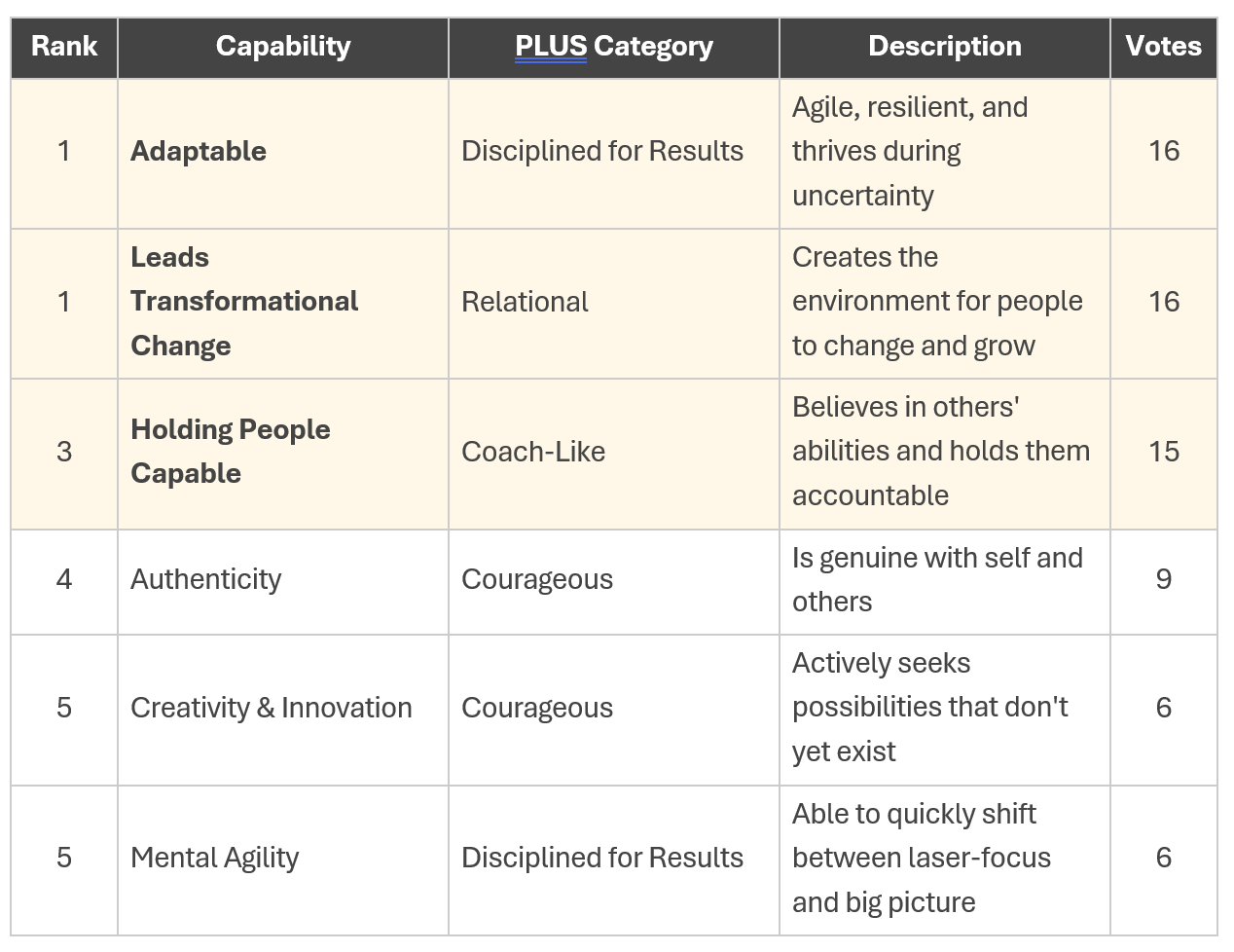
At the CPHR Alberta Conference, we asked HR leaders one question: What leadership capability matters most for the future of your organization? Leaders picked up a star and placed it beside their answer. By the end of the conference, HR leaders cast 131 votes across 16 capabilities. Three stood out, with two tied for first place. Here is what they told us.
What the Data Showed
The capabilities on the board came from Bright Wire's PLUS Leadership Framework, a proprietary model built to define what effective leadership looks like across every level of an organization and is organized across four dimensions:
- Courageous
- Coach-Like
- Disciplined for Results
- and Relational
The results below reflect the capabilities HR professionals believe matter most.
Why These Results Matter
You might look at those top two capabilities and think: adaptability and leading through change, again? These topics have been flagged frequently over the past five years. But before you move on, consider this: if leaders already knew how to do these things well, the HR professionals at the conference would not have voted the way they did. The gap here is not awareness but execution. And that is exactly where HR professionals can use the strategies below to close that gap.
The Three Capabilities and How HR Can Build Them
1. Adaptable
On adaptability, Robynn Stirrett, MEd, PCC, Certified Executive Leadership Coach and Master Facilitator, was on site to gather the data and notes that “leadership development has traditionally been about helping people learn new skills. The next generation of leadership development will help leaders let go of outdated assumptions. In a world where certainty has a shorter shelf life, adaptive capacity becomes as important as competence.”
Three ways to build this capability:
- Embrace scenario-based learning
Give leaders real situations where they must make decisions without all the answers. Adaptability grows through practice.
- Build structured post-change debriefs
After a change, ask: what did you learn, and what would you do differently? That reflection accelerates adaptability.
- Assess adaptability in talent reviews.
Add a direct question: how does this leader respond when the plan changes? Make it visible to develop and track it.
2. Leads Transformational Change
When change is announced but not truly led, the initiative stalls. That gap comes down to developing leaders capable of driving transformational change.
Three ways to build this capability:
- Distinguish change communication from change leadership
Clear communication is not enough. The real skill is helping people work through resistance and uncertainty while building trust that keeps everyone engaged.
- Equip leaders with a framework for transition conversations
Give leaders a simple structure to check in with their people: Where are you in this change? What do you need? What is getting in the way? Leaders who do this effectively move their teams through change.
- Make leader check-ins part of the project plan
Build coaching checkpoints into your project timelines. When leaders know these conversations are expected and tracked, their behaviour shifts.
3. Holding People Capable
When leaders step in and do the work themselves, team capability suffers. How a leader holds their people capable determines not just individual performance but overall team health.
Three ways to build this capability:
- Redesign performance conversations
Train leaders to ask, "What support do you need to deliver this?" before "Why was this not done?" One builds capability; the other enforces compliance.
- Teach delegation of outcomes, not tasks
When leaders assign tasks, they keep control. When they assign outcomes, they build capability. Make this distinction explicit in your management development programs. For a deeper look at how this shift works in practice, see From Accountability to Capability: Shifting How You Empower Your Team.
- In succession planning, ask leaders to name two people they are developing for expanded roles.
If they cannot answer, that is your signal to be proactive and spot where to invest before the gap becomes urgent.
A Signal Worth Acting On
You already know what your organization needs. Often, the most useful starting point is not a new framework or a longer list of priorities, but a clear signal of where leaders are asking for support, and the confidence to build your development strategy around it.
Christine Dagenais, MBA, PCC, ICD.D is the Founder and CEO of Bright Wire Leadership, a Calgary-based leadership development firm specializing in executive coaching, leadership programs, and organizational capability building. With more than 20 years of experience in leadership development, she has coached thousands of leaders across North America and was recognized as one of Canada's Top 100 Most Powerful Women.
Bright Wire Leadership is a Calgary-based executive coaching and leadership development firm that works with high-performing leaders and organizations across North America. Their team of ICF-credentialled coaches specializes in executive coaching, leadership development programs, and organizational capability building. Bright Wire is Where A Players Find Their Plus.
The views and opinions expressed in this blog post belong solely to the original author(s) and do not necessarily represent the views and opinions of CPHR Alberta.